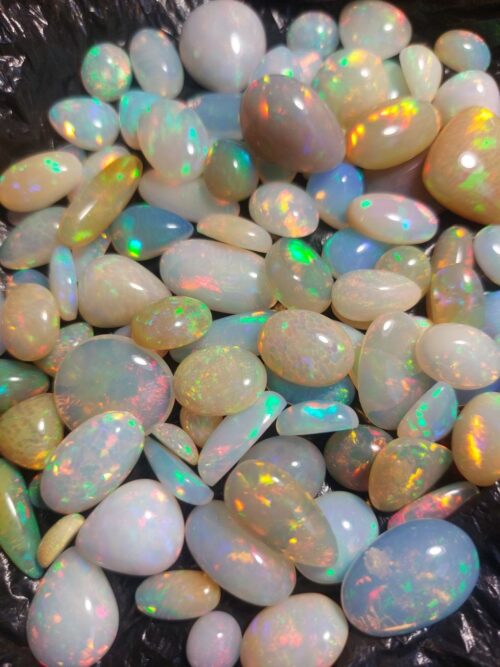
Opals are made of hydrated silica, opals are known for their beauty and mystical charm that radiates through their unique “play of color” (flashes of color that change with the stone’s movement). Opals contain water (ranging from 3% to 21%) and are considered mineraloids rather than minerals because, unlike most other gemstones, they are not crystalline. The word ‘opal’ stems from the ancient Sanskrit word upala (meaning ‘stone’ or ‘precious stone’). It is also believed to have derived from the Latin ‘opalus’ (meaning ‘precious stone’) and the Greek ‘opallios’ (meaning ‘to see a change in color’). Archaeological evidence shows that opals were discovered over 10,000 years ago in North America and around 6,000 years ago in Kenya. Opal gemstones have played a role in the history of many cultures and regions.
The ancient Greeks believed opals were the tears of joy shed by Zeus after his victory over the Titans. The ancient Romans associated them with hope, love, and good fortune. According to Arabian folklore, opals descended from the heavens in flashes of lightning. During the Middle Ages, people wore opals as amulets to protect against evil. In some cultures, they were also thought to bring misfortune. In fact, some people even attributed supernatural powers to opals, linking them to mystery and superstition. In the modern era, opal gemstones gained actual popularity in Europe after Queen Victoria’s fondness for them. Many artifacts found in ancient civilizations prove that opals have been traded as a commodity for thousands of years. But it became a vital part of international trade in the 19th century, with Australia emerging as the primary source, producing 95% of the world’s opals. The discovery of the black opals in the early 20th century made these gemstones even more popular. Found in Lightning Ridge (New South Wales), black opal soon became the most sought-after variety among opal buyers worldwide. However, during the Great Depression of the 1930s, the opal market crashed, and it took many decades for the market to get back on track. After the discovery of Ethiopian opal in the 1960s, the value of opals grew notably in the international market. And today, opal gemstones are traded globally, with Australia, Ethiopia, and the United States being key market players.
Opal Gemstones in Global Trade: Exploring Demand and Major Sources Just like their iridescent radiance, the global demand for opal gemstones never fades. There are a variety of cultural, aesthetic, and commercial factors responsible for it. We already know that opals are valued for their play-of-color and one-of-a-kind appearance. But do you know that in several regions (like India, Thailand, and China), opals are also associated with emotional healing, creativity, and spiritual grounding? The allure of opals extends beyond their visual charm to their intriguing symbolism. Many people believe that they instill a sense of calm and balance in the wearer and possess energy-enhancing properties. Opal gemstones are the birthstone for October, and they are linked to the planet Venus in Vedic astrology. Thus, they are said to enhance love, beauty, and creativity. Besides the spiritual, astrological, and metaphysical beliefs, opal stones have carved their own niche in the era of personalized jewellery and sustainable luxury. When it comes to fashion and custom jewellery, the admiration for opal gemstone pieces (such as opal earrings and opal stone rings) continues to grow. Recent years have seen a drastic increase in cross-border trade among opal gem buyers and suppliers. If you are an exporter or supplier of natural opal gemstones, you should be aware of their major sources and the regional variations in opal deposits, which often affect their value and market positioning.
Different Sources of Opal Gemstones:
Source Country
Features
Australia
Home to the world’s finest black opals (Lightning Ridge), white opals, and boulder opals
Major source regions include South Australia, New South Wales (Lightning Ridge), Queensland, and the Great Artesian Basin.
Ethiopia
Known for bright, colorful, translucent opals (especially black and fire opals)
Lower cost but growing in popularity
Mexico
Famous for fire opals (orange to red in color)
Major mining regions include Querétaro, Jalisco, and Guerrero
Brazil
Offers milky white opals and crystal opals with good clarity
Produces various types, with notable deposits in Minas Gerais
USA
Small-scale mining of white and black fire opals (mainly for domestic collectors)
Major mining regions include Nevada and Oregon
Indonesia
Produces low-density volcanic opals (including rare blue opals)
Indonesian opals (mainly found in West Java) are sometimes discovered in fossilized wood
What are the Most Sought-After Opal Varieties for Import and Export? Essentially, there are two major opal types, and these are precious opal and common opal. Precious opals show the iridescent effect (known as play-of-color) and include many subtypes such as white opal, black opal, boulder opal, fire opal, and crystal opal. On the other hand, common opals lack this optical phenomenon but also come in many varieties, including jelly opal, Mexican opal, Peruvian opal, blue opal, and matrix opal. In addition, there are also other classifications (like synthetic opals, opal doublets and triplets, etc.), which are usually man-made or assembled forms. Here are some of the commonly traded and most sought-after opal varieties among gemstone buyers.
Type of Opal
Appearance
Origin/Source
Key Characteristics
White Opal
Milky white body with soft, pastel play-of-color
Australia, Brazil
Common and affordable
Subtle iridescence
Black Opal
Dark body tone with vivid color play
Australia (Lightning Ridge), Ethiopia
Highly valuable
Strong contrast in color flashes
Fire Opal
Transparent to translucent with red, orange, or yellow body; may lack color play
Mexico, USA, Brazil
Valued for body color
Rare specimens show play-of-color
Boulder Opal
Vivid color patches within ironstone matrix
Australia (Queensland)
Durable due to host rock
Unique natural patterns
Crystal Opal
Opal distributed through host rock like sandstone or ironstone
Australia, Ethiopia
High clarity and brightness
Prized in fine jewelry
Matrix Opal
Opal distributed through host rock like sandstone or ironstone
Australia
Earthy appearance
Natural stone texture visible
Doublets
Thin slice of opal backed with darker material
Assembled (Australia, Ethiopia)
Enhances color
More affordable than solid opals
Triplets
Opal slice with backing and a clear top (quartz or glass)
Assembled (Australia, Ethiopia)
Budget-friendly
Often used in commercial jewellery
Peruvian Opal
Opaque to translucent in pastel pink or blue-green
Peru
No play-of-color
Used in beads and cabochons
Mexican Opal
Bright fire opals (usually orange-red), sometimes with color play
México (Querétaro, Jalisco)
Known for fiery body tone
Sometimes overlaps with fire opals
Pink Opal
Solid pink to rose-colored, opaque
Peru
Calming, decorative
Lacks play-of-color
Blue Opal
Translucent to opaque blue or blue-green
Peru, Indonesia, USA (Oregon)
Soothing tones
No play-of-color
Purple Opal
Opaque with lavender to purple hue
Mexico, USA (Nevada)
Quite rare
Generally no play-of-color
Green Opal
Opaque to translucent green shades
Australia, Madagascar, Tanzania
Typically common opal
No play-of-color
Hyalite Opal (Glass Opal)
Colorless, glass-like transparency with green fluorescence
Mexico, USA, Hungary
Lacks color play
Glows under UV light
Honey Opal
Golden to amber body color, usually translucent
Mexico, Ethiopia
Occasionally shows play-of-color
Warm golden tones
Water Opal
Transparent to translucent with faint play-of-color
Mexico
Delicate, ethereal appearance
Sometimes called crystal or jelly opal
Contraluz Opal
Exhibits play-of-color only when backlit (light shines through)
Mexico
Rare optical type
Colors visible best when illuminated from behind
To attract a larger buyer base and increase profitability, opal gemstone exporters often diversify their offerings by trading in other related categories, such as:
Semi-precious gemstones, including aquamarine, beryl, citrine, iolite, jade, onyx, spinel, tanzanite, and topaz High-value and traditional gemstones, such as amber gemstones, ruby gemstones (Manikya), emerald gemstones (Panna), and pearl (Moti) Gems & Jewellery, including handmade or set gemstone jewelry for international orders
Opal Gemstones Global Market Insights: What Exporters Should Know Learning about key market insights and trends can help exporters discover global opportunities and make data-backed decisions for their business. From market size and top opal gemstone importers to price trends, here’s everything you need to know.
While specific market size data for opal gemstones is currently unavailable, here is the market size for gemstones as a broader category.
Global Gemstone Market Size:
Metric
Value
Market Size (2024)
USD 34,110.1 million
Market Size (2025)
USD 36,044.1 million
Expected Market Size (2035)
USD 68,151.4 million
CAGR (2025-2035)
6.60%
Source: Future Market Insights
Top Opal Gemstones Importing Countries:
Country Name
Total Shipments
Singapore
7,332
India
3,987
United States
3,138
Source: Volza
Average Price Range for Popular Opal Stone Types
Opal Type
Price Range (USD)
White Opal
$20 – $200 per carat
Black Opal
$500 – $5,000+ per carat
Fire Opal
$50 – $500 per carat
Boulder Opal
$100 – $3,000 per carat
Crystal Opal
$100 – $2,000 per carat
Ethiopian Opal
$30 – $500 per carat
Common Opal
$10 – $100 per carat
Source: GemsRoot
How to Find Verified Opal Gemstones Buyers Near Me or Globally? Whether you are looking for opal gemstone buyers online globally or near you, here are the most effective methods:
Sign up on B2B marketplaces or www.miraclegemstone.com to connect with verified opal gemstone buyers instantly. Meet potential buyers in person by attending international trade shows & gem fairs like Tucson Gem Show (USA), Hong Kong Jewellery & Gem Fair, or India International Jewellery Show (IIJS). Get access to opal gemstone buyers & importers databases by registering on Export Promotion Councils such as the Gem & Jewellery Export Promotion Council (GJEPC) in India or the Australian Opal Association. Work with local gemstone associations or Chambers of Commerce to access export support services and market entry directories. Reach out to your network of traders, miners, or jewellers and ask for referrals for opal gem buyers.
Frequently Asked Questions (FAQs):
How to get opal gemstone buyers? You can get opal gem buyers through:
Does opal have resale value? Yes, precious opals, especially varieties like black opals, boulder opals, and fire opals, have good resale value. However, it depends on quality, rarity, and market demand. However, common opals may have limited resale value.
What determines an opal’s value? The value of opal is determined by:
Type (black, white, boulder, fire, etc.) Play-of-color (intensity, range and pattern of colors) Body tone and transparency Clarity & brightness Size, shape, and cut Origin (Australian black opals are highly valued) Treatment status (untreated opals are usually more valuable)
How can I tell if an opal is real? You can follow these steps to identify a real opal:
Find our irregularities in the color play & structure Check for cool-to-touch feel and natural imperfections Use a gem tester or consult a professional gemologist Synthetic opals have a uniform, pixel-like pattern
Where is opal commonly found? Opals are commonly found in:
Australia (Lightning Ridge, Coober Pedy, Queensland) Ethiopia (Welo and Shewa regions) Mexico (Querétaro) Brazil, Peru, USA (Nevada, Oregon) Indonesia
What are the major opal importing countries? Top opal gem importers are:
Singapore India United States
What are the key factors to consider when exporting opal? When exporting opal gemstones, consider:
What challenges exist in the opal mining and export industry? Some key challenges in the opal mining and export industry include market volatility, price fluctuations, risk of synthetic and treated stones (which reduces buyer trust), environmental impact of mining, regulatory barriers, export documentation, limited access to international buyers for small-scale miners, and ethical sourcing concerns.
What is the opal gemstones HSN code? 7103 is the opal gemstones HSN code.
What is the Indian Customs Duty on opal under HSN 71031090? The Indian Customs Duty on opal under HSN 71031090 is:
Basic Customs Duty (BCD): 10% Social Welfare Surcharge (SWC): 10% Health Cess: 0% Integrated Goods and Services Tax (IGST): Usually 18% (may vary)
Latest News Related to Opal Gemstones Global Trade: The global colored-gemstone market is set for strong growth in 2025, with steady retail demand, especially for rare, high-quality stones (like black opals), now gaining attention alongside sapphires and spinels. (Full Story: RAPAPORT).